- Foundations: Confidentiality Integrity, and Availability
- Authentication and Identification
- Access Control
Foundations: Confidentiality Integrity, and Availability
The Three Fundamental Concepts of Security: CIA
- Confidentiality
- Protecting information from disclosure to unauthorized parties
- Integrity
- Protecting information from being modified by unauthorized parties
- Availability
- Ensuring that information is available (accessible) to authorized parties
Authentication and Identification
To decide if a subject(e.g a human person) is a member of an authorized party that can access (i.e execute an operation such as read, write, or execute on) an object (resource) (i.e a physical object, a function call, data/information), we need to solve
- Identification
- Associating an identity with a subject
- Authentication
- Verifying the validity of something (usually the identity claimed by a system entity)
- Authorization
- Granting (or denying) the right or permission of a system entity to access an object
- Access Control
- Controlling access of system entities (on behalf of subjects) to objects based on an access control policy (“security policy”).
Mechanisms for Identity Authentication
- Something that you know
- e.g password or a PIN
- Something that you have
- E.g a smart card or a one-time password generator
- Something that you are
- E.g Biometric characteristics e.g a facial scan/photograph
- Context location, e.g your current location
- E.g being physically close to an object, being in a secure building
Example of Something That You Know: Passwords
- Passwords
- Are widely used
- Hard to remember
- Good passwords are: long and random
- Good systems:
- Allow for passwords of arbitrary length
- store passwords hashed and salted
- Questions that we are interested in
- How to store and validate passwords securely
- How to access systems securely that require a password
Example of Something That You Have: Hardware Tokens
- Examples
- Chip Cards
- One-time password generators
- Your UniCard
- Today, we see a shift towards soft-tokens, eng. a one-time password app on your mobile
- Is your UniCard a good hardware token?
Example of Something That You Are: Biometrics
- Uses characteristics of your body. e.g
- Fingerprint
- Retina Scan
- On the first sight: very promising
- Many unsolved problems:
- Is a fingerprint a secret protected by the first amendment, i.e the protection of free speech
- Biometric sensors can be tricked
Access Control
- Typical Access Control System focus on authorization:
- Specification of who is allowed to do what (permissions)
- How to update/change permissions
- A simple access control model is a relation
- Example of a simple permission check:
- In reality, quite complex:
- Might depend on the system state (or context)
- Subjects and permissions change over time
- Access rights might require the fulfillment of obligations
- implementation bugs
- Access control needs to be enforced
Forms of Access Control
- Access Control might come in various forms:
- Physical protection
- e,g gates, turnstiles
- Network traffic
- e.g firewalls
- Hardware
- e.g memory management
- Operating System
- e.g file system
- Application level
- e.g Google login, databases
- Physical protection
Policies vs Models
- A security policy defines what is allowed (and/or forbidden)
- It is analogous to a set of laws
- Defined in terms of rules and/ or requirements
- A security model is a (formal) representation if a class if systems (and their behavior)
- highlights security features on a chosen level of abstraction
- provides a vocabulary to develop specific policies
The Access Control Matrix Model
(Introduction)
- Based on the ideas of privileges of subjects on objects
- Subjects: users, processes, agents, groups
- Objects: data, memory banks, other processes, files…
- Privileges: right to read, write, modify
- Abstract: a model
- Implementation: a mechanism
(Protection State)
- A protection state, relative to a set of privileges , is a triple with:
- A set of current subjects
- A set of current objects
- A access control matrix , defining
- the privileges for each , i.e
- a relation
- equivalently, a function
- Example
- Does this scale ?
- What about systems with thousands (millions) of subjects and objects?

Role-Based Access Control (RBAC)
(Introduction)
- How can we formalize a policy for more than
- thousands or millions of subjects
- a similar number of objects
- An Access Control Matrix is most likely unmaintainable
- Observation
- Subjects(users) often have roles e.g
- customer, employee, student
- Roles share the same rights e.g
- students can attend lecture
- Subjects(users) often have roles e.g
- Core idea of RBAC
- Create roles for job functions in enterprises
- Assign users to roles (based on their responsibilities)
- Assign a set of permissions to each role
- RBAC decouples users and permissions by introducing roles
Formalization
- RBAC is formalized by
- a set of ROLES
- a set of USERS
- a relation
- a relation
- The access control model is
i.e
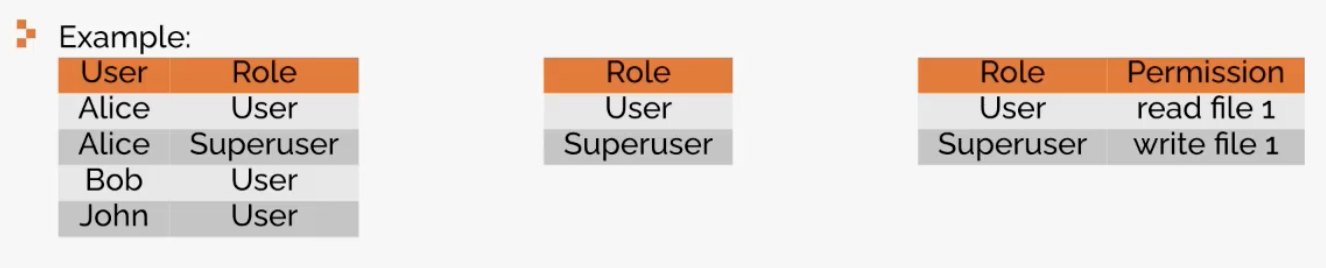
Or formally
- What are the permissions of John?
- What are the permissions of Alice?
Extending RBAC
- Would recommend simple RBAC to your bank?
- role hierarchies
- who can change permission
- context information (constraints, e.g subject must be the owner of the object)
- users switching roles
Hierarchical RBAC
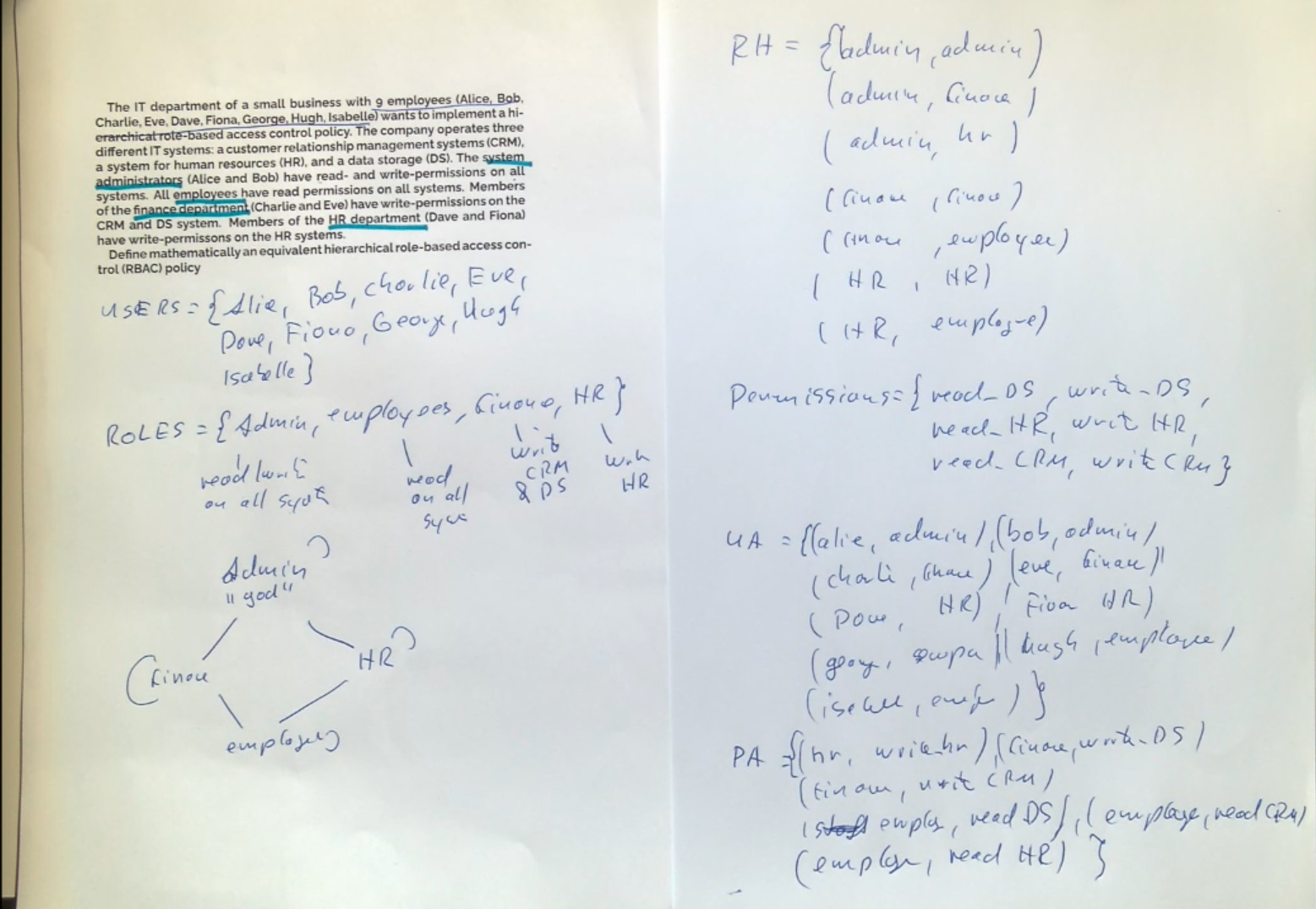
Hierarchical RBAC extends RBAC with a role hierarchy :
- a set of
- a set of
- a relation
- a relation
describing the role hierarchy - a relation
The access control model is:
i.e
Compartments
A compartment (or category) specifies a domain for need-to-know policy. Examples: SAT= Satellite Data, EUR = Europe, ASI = Asia.
- Compartments are critical in complex coalitions
- Examples
- The US may also have allies that do not with to share information(perhaps the UK and Canada, Policy must support)
- Top Secret, UK
- Top Secret, Canada
- Top Secret, UK and Canada
Labeling and ordering
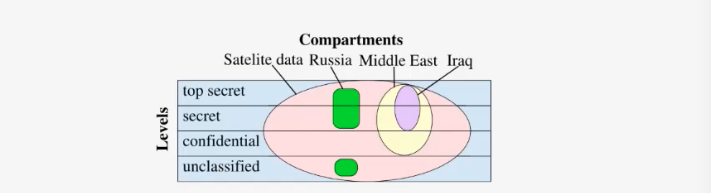
- Both notions of classification induce an ordering
- Bell and La Padula suggesting using lattices here
- You can only see information if you are cleared to access all categories labelling it under the ordering relation
Partially-ordered sets
- A set with a relation , written , is partially ordered
- if is:
- Reflexive:
- Transitive: if and then a
- Anti-symmetric: if and . then
- Examples
- Natural numbers with less-than-or-equal (total order)
- Sets under subset relations (not a total order)
- Natural numbers ordered by divisibility
Latices
- A partially ordered where for all there exists a least upper bound and a greatest lower bound , i.e
Examples - Natural numbers in an interval () with less-than-or-equal
- Linear order of clearances
- Powerset of a a set under inclusion (of security categories e.g SAT, EUR, ASI)
Moreover, you build new lattices from existing ones, e.g by component-wise combination(lattice product)
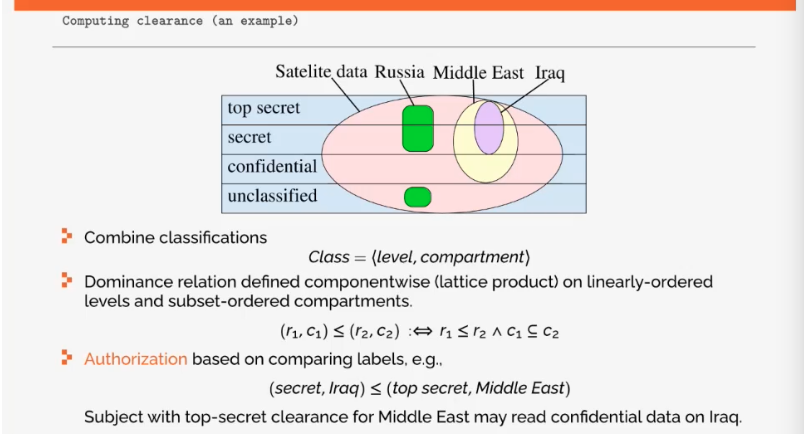
Computing clearance (an example)
Why lattices
- Recall all pairs of lattice elements have a least upper bound and a great lower bound
- If labels form a lattice, we can uniquely answer questions like
- Given two objects with different labels. what is the minimal label a subject requires to be allowed to read both objects?
- Given two subjects with different labels, what is the maximal label an object can have that can still be read by both subjects?
- Well suited for need-to-know policies, where each subject is assigned a label reflecting least privilege required for his function
The Bell-Lapudla (BLP) Model (1975)
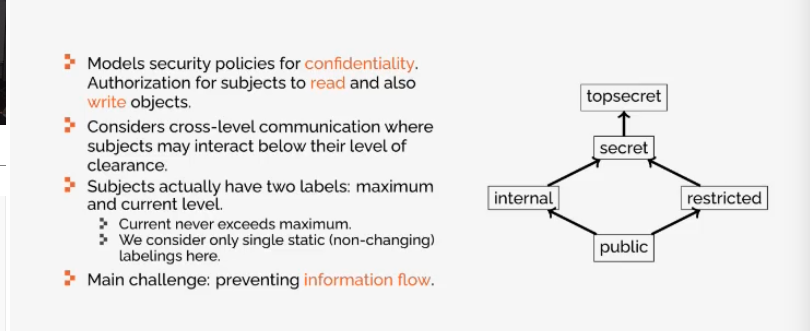
BLP Setup
- Combines lattice on labels with state-transition systems
- Access decisions satisfy following properties
- Read-down (also called Simple Security Policy)
- A subject with label , can only read information in an object with label if dominates
- Write-up (also called Property)
- A subject with label can only write information to an object with a security label dominates
- Read-down (also called Simple Security Policy)
- Main Insight: Prohibiting write down is essential confidentiality as otherwise information can effectively be reclassified.
BLP — disallowed operations
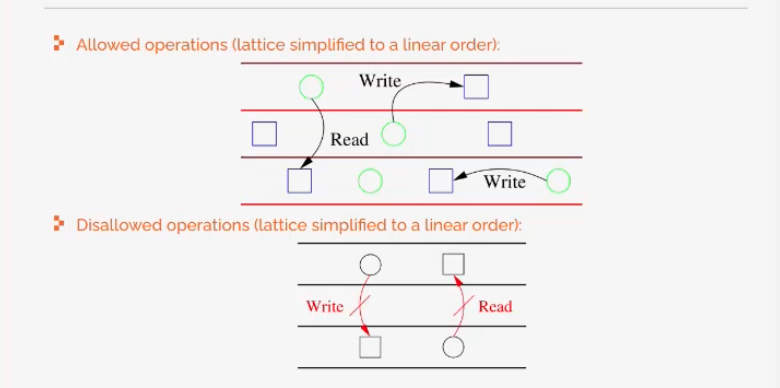
BLP — Conclusions
- No information leakage possible! (if implementation secure)
- No read-up and no write-down prevent subjects from simultaneously having read access to information at least one level and write access to information at a lower level.
- Since MAC. labels cannot be changed (by subjects or malware)
- But also prevents “legitimate” communication from high-level subjects to low-level ones. Possible solutions
- temporarily downgrade the subject’s security level
- Identify a set of trusted subjects that may violate the star-minus property
- Mechanism support provided by some systems, e.g BLP module for SELinux
Other Access Control Systems
- Discretionary access control (DAC): owners can change permissions
- Example: unix/ linux file system
- Break-Glass access control allows to override the access control “in emergencies”
Next Step After Access Control: Usage Control
- Traditional access control(as discussed previously) focuses
- controlling access to documents/data/information
- decisions that are fast to evaluate/decide
- decisions that can immediately be enforced
- Usage Control
- controlling the use of documents
- you are allowed to read the book but no give it to someone else
- you are allowed to watch this movie three times within the next two weeks
- Techniques used for usage control or (DRM Digital Rights Management)
- watermarking (violations/misuse is pursued economically/legally)
- monitoring (easier in a closed/trusted environment. e.g using a trusted OS and/ or a trusted viewer)
- controlling the use of documents
Key Take-Aways
- Traditionally, the three fundamental goals of cybersecurity are
- Confidentiality
- Integrity
- Availability
(Already the three CIA goals are conflicting!)
- Common access control models are
- DAC, often used in end-user file systems
- Extended RBAC models, often used in business software
- Bell-LaPadula variants are common in military applications
- Access control list/matrix models are often supported by file systems
- Many access control models have a similar expressiveness(one can be emulated by other)
One-Time Pad (OTP) encrypts m1…mnm1…mn with a random key k1…knk1…kn via ci=(mi+ki) lci=(mi+ki)modl, giving perfect secrecy if the key is truly random, as long as the message, and never reused.