02 Geometry and kinematics
Home | Previous: 01 Math for Learning | Next: 03 Dynamics and Feedback
Kinematics describes motion geometry without asking which forces cause it. A point is meaningless without its coordinate frame: a target 10 cm to the camera’s right is not necessarily 10 cm to the robot’s right.
Transforming coordinates
A rigid transform combines rotation and translation :
The superscript says which frame expresses the coordinates; the matrix above maps coordinates in B into A. Rotation matrices satisfy and . Transforms compose by matrix multiplication:
The order matters.
is expressed in frame B, so it acts along B’s axes after the move to B, and C lands at . Swapping the product applies it along A’s axes first, and the frame ends at , 2.55 away. Source: Tools/animations/ch02_frame_composition.py.
A two-link arm you can understand completely
For link lengths and revolute joint angles measured in radians:
These are forward kinematics: angles become a tool position. Inverse kinematics asks for angles that reach a target. It can have multiple solutions or no solution.
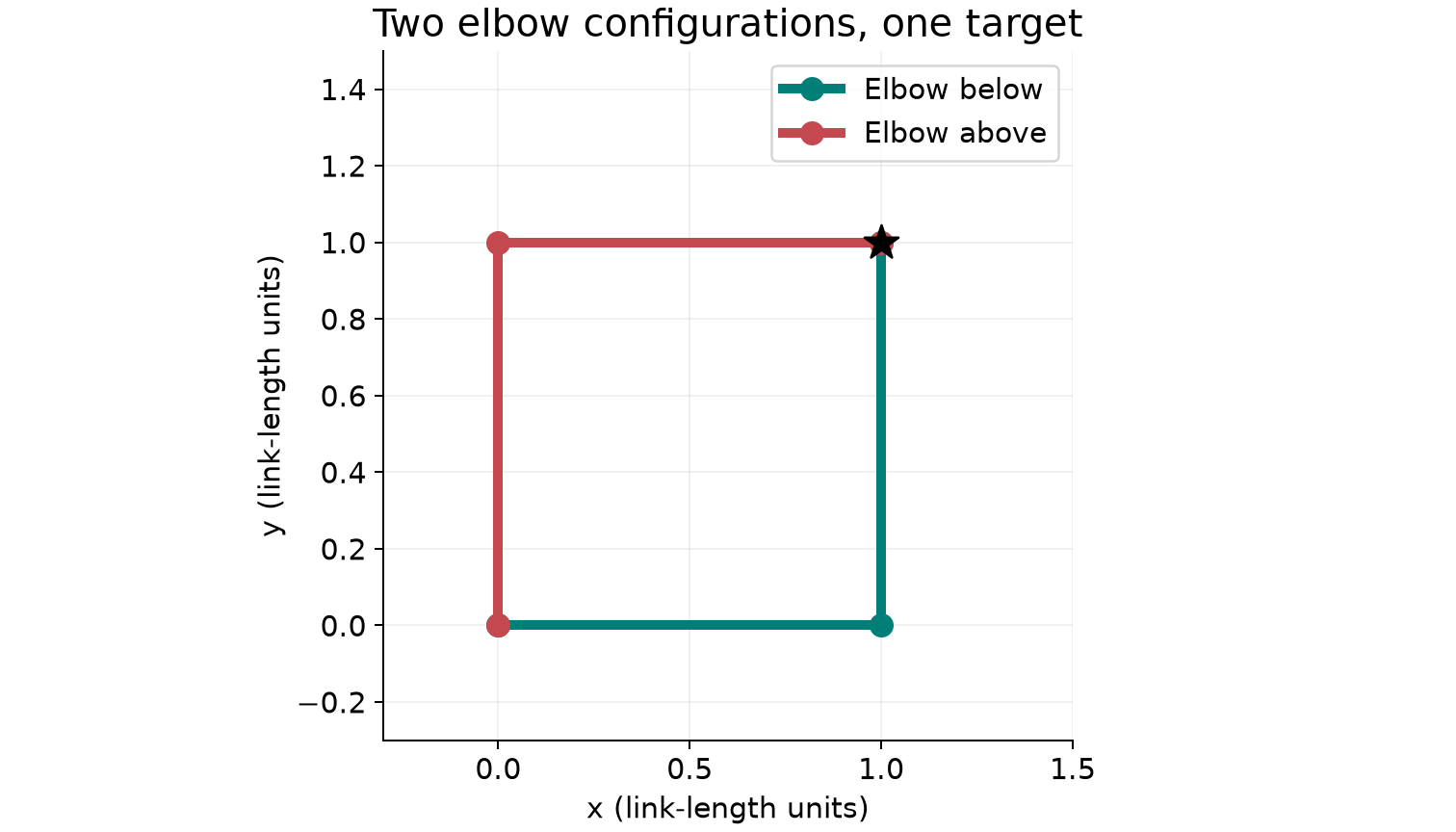
Two exact configurations with unit-length links; different elbow configurations can reach the same point.
For a target at distance , reaching requires . This geometric condition ignores obstacles, joint limits, tool orientation, and collisions.
The Jacobian connects small movements
Here . At some configurations, loses rank: certain tool velocities cannot be produced instantaneously. This is a singularity. Near a singularity, solving for joint motion can amplify small target changes. A damped least-squares step uses
where trades exact tracking for bounded motion. It still needs joint and collision checks.
Damped least-squares IK with , . The gold ellipse is every tool velocity reachable with unit joint speed; watch it flatten as the arm straightens toward an unreachable target. Source: Tools/animations/ch02_arm_ik.py.
Exercise
Set , . Find the tool position and Jacobian. Which instantaneous direction is unavailable?
The tool is at and . First-order movement along the x axis is unavailable at this straight configuration.
Continue with Lab 01 Planar Arm. For formal treatment of frames, rigid motions, and kinematics, use the authors’ Modern Robotics materials.