06 Imitation and distribution shift
Home | Previous: 05 Training Neural Policies | Next: 07 ACT and Action Sequences
Behavior cloning learns actions from demonstrations. The trap is that a robot’s mistakes change which states it sees next. Demonstrations of successful grasps may never show the gripper slightly missing the object, so the policy may have no idea how to recover.
The distribution you train on is not the one you create
Let be the expert’s state distribution and the learner’s. Behavior cloning minimizes error under , but deployment runs under . These distributions coincide only under restrictive conditions.
In a deliberately simplified model, suppose each of steps independently avoids an unrecoverable error with probability . Then
This explains why apparently small step errors can hurt long tasks. It is not a theorem for general robotic behavior: errors are often correlated, and recovery can be possible.
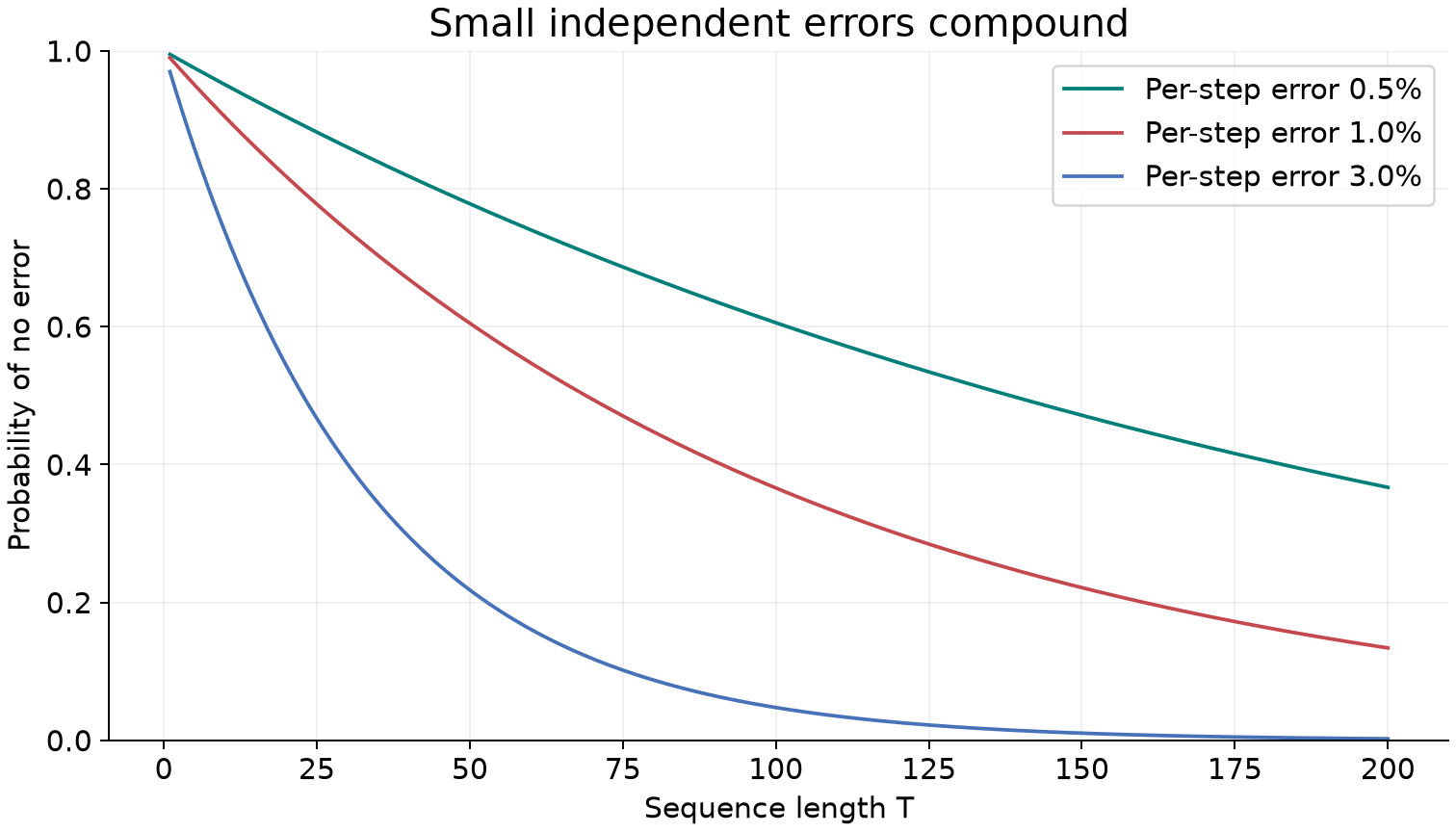
Independent-error illustration, not an empirical success curve.
Improving the data distribution
The DAgger paper motivates repeatedly collecting expert labels on states visited by the learner and aggregating them into the dataset. Its theoretical guarantees rely on assumptions; applying the idea to hardware requires a practical expert and controlled execution.
A toy lane-keeping task. The expert keeps the lateral error small, so its demonstrations barely show how to correct one, and a linear policy fitted with weight decay learns almost no correction (gain against the expert’s ). Over 500 runs, its share still in the lane falls from 94% after 50 steps to 60% after 300. One DAgger round, with the expert labelling 142 off-centre states the learner reached, raises the gain to and keeps every run in the lane. Noise and weight decay were chosen to make the effect visible. Source: Tools/animations/ch06_compounding_dagger.py.
flowchart LR
  Demo["Expert data"] --> Train["Train learner"]
  Train --> Roll["Observe learner states"]
  Roll --> Label["Expert labels or corrections"]
  Label --> Merge["Aggregate data"]
  Merge --> Train
Corrections are not automatically better data. If a human intervenes only during the worst states, that subset has a different distribution from normal operation. Record when intervention happened and evaluate whether the resulting policy improves independent test rollouts.
Your SO-101 interpretation
Start with one simple task, consistent resets, and a fixed camera. Collect examples of reasonable object variation and recovery from small, safe perturbations. Measure whether extra diversity helps more than more near-duplicate demonstrations.
An action policy can also be ambiguous because demonstrations encode several strategies. Better data collection, conditioning, and stochastic output models solve different parts of this problem.
Exercise: with , compare the illustrative no-error probability for and .
About 0.904 and 0.366. The assumptions are independence, fixed error probability, and no recovery. Explain why each is unrealistic before treating the numbers as a prediction.
Paper bridges: ACT and ALOHA - 2304.13705, EgoMimic - 2410.24221. Research connection: Recovery Data versus More Demonstrations.