10 Offline RL and data coverage
Home | Previous: 09 Reinforcement Learning | Next: 11 World Models and Planning
Offline reinforcement learning uses a fixed dataset of transitions. This is attractive when robot interaction is costly: reuse logged experience instead of collecting every trial anew. The central difficulty is estimating the value of actions that the dataset barely contains.
Why maximization can amplify error
A simple Q-learning target is
where indicates a true terminal state and denotes target parameters. The maximization may select an unsupported action with an accidentally high predicted value. Training then propagates that error.
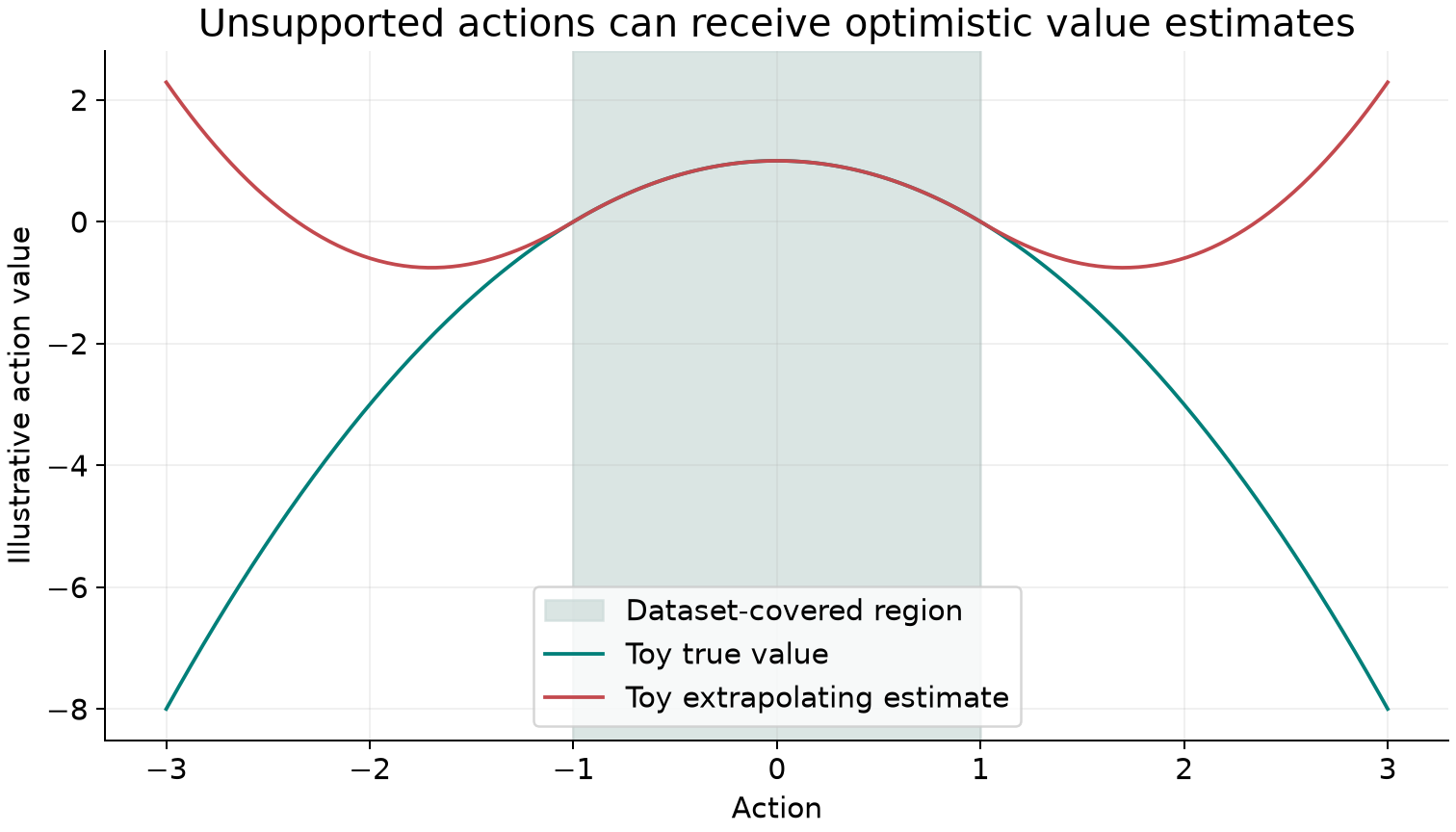
Synthetic action values: a fitted estimate can look optimistic outside the region covered by data.
One state, logged actions only in . A degree-4 fit agrees with the data, but its maximum is at , predicting 21.8 where the true reward is . Maximising an ensemble’s mean minus two standard deviations, a simple pessimistic estimate, picks (true reward 0.97). Bootstrapping with multiplies the error in the max by . Across 200 random datasets the greedy pick left the data 52% of the time. Source: Tools/animations/ch10_offline_overestimation.py.
Offline methods address this through ideas such as pessimistic value estimates, restricting how far the policy departs from the data, or learning advantage-weighted imitation. The appropriate constraint depends on whether the dataset includes diverse successful behavior, recoveries, or mainly failures.
Coverage is a physical question
Ask which states and actions your dataset contains. A hundred successful demonstrations from one initial pose may cover less useful variation than a smaller set spanning different poses and recoveries. More frames do not necessarily mean more independent experience.
If a dataset has only expert actions and no usable rewards, behavior cloning may be the clearer starting point. Offline RL needs a defensible reward or outcome signal and sufficient transition information. Reconstructing a reward after collection can introduce label noise.
Practical distinctions
Offline RL improves reward using fixed logged transitions. Off-policy online RL learns from a replay buffer but can still collect new experience. Offline evaluation estimates deployment performance from logs; it is a separate problem and can be unreliable when the candidate policy differs greatly from the logging policy.
Exercise: your data contains only slow movements near the center of the workspace. A learned Q-function predicts very high return for fast movements at the edge. Is that evidence the fast policy works?
No. Those predictions extrapolate outside coverage. You need either evidence in that region or an algorithm and evaluation protocol that explicitly address the uncertainty.
Connection: 06 Imitation and Distribution Shift explains the related distribution mismatch for imitation. For deeper primary reading, see Conservative Q-Learning and Implicit Q-Learning; these are further-reading links, not claims of implementation or replication here.