11 World models and planning
Home | Previous: 10 Offline RL and Data Coverage | Next: 12 Human Data and Embodiment
A world model predicts how a state or representation changes after an action. Planning uses that prediction to compare possible futures. It can use a known physics model, a learned transition model, or both.
Planning over a finite horizon
With a learned deterministic dynamics model :
is running cost and is terminal cost. Constraints may restrict joint limits, speed, collision, and contact. Model predictive control executes the first part of the plan, measures again, and replans.
Why a good-looking video is not enough
A model can generate visually plausible futures that are physically wrong. More importantly, a useful action-conditioned model must predict how different actions change outcomes. A video predictor that ignores the proposed action may look convincing and still be useless for control.
If per-step model error is at most and error propagation has Lipschitz factor , a simplified bound starting from zero error is
For , this bound grows quickly. It requires uniform error and sensitivity assumptions that often do not hold globally; it illustrates why long rollouts can be unreliable.
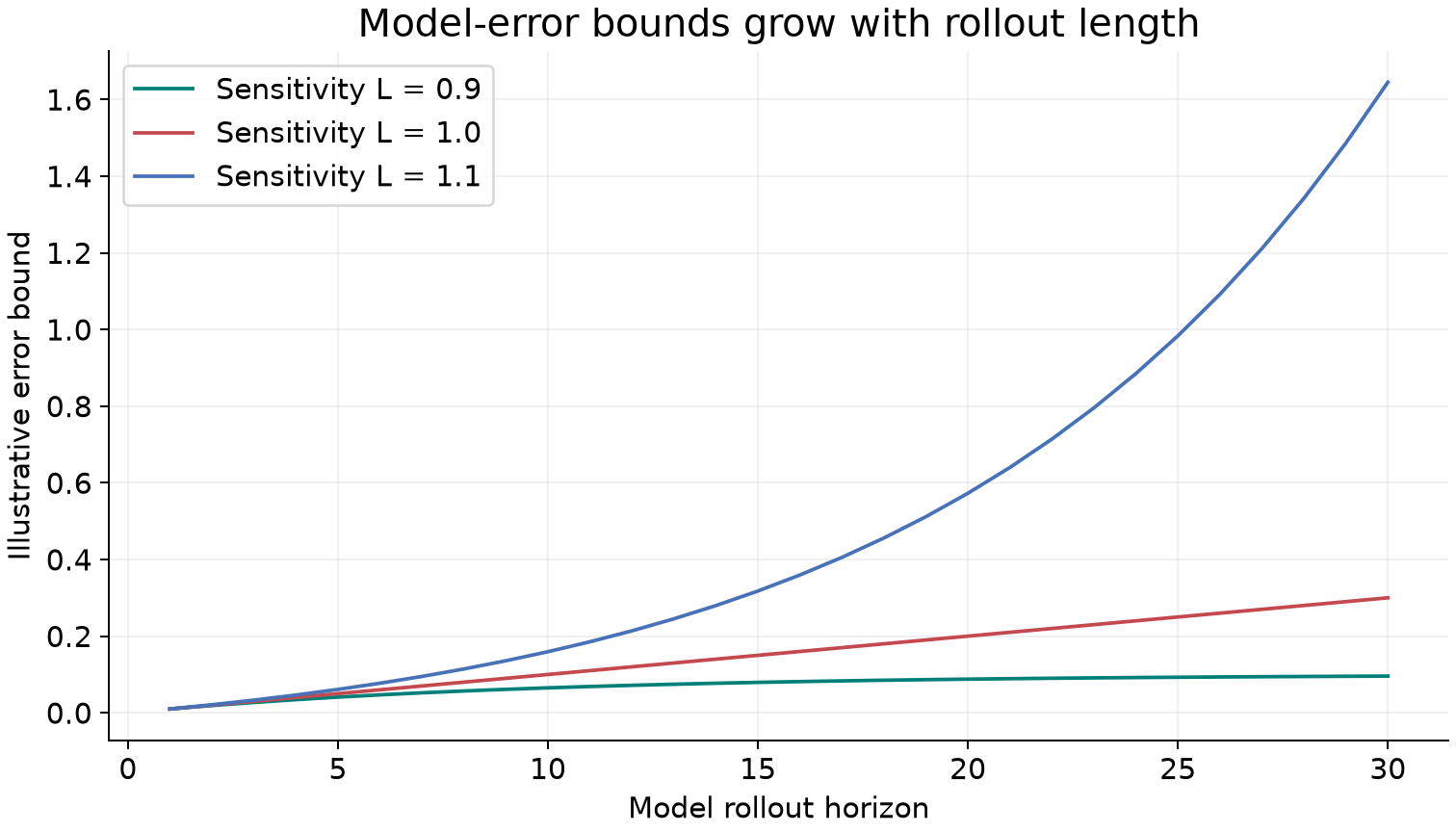
Analytic illustrative bound for different sensitivity factors.
A puck on a tilted table. The learned model has the wrong friction (0.2 instead of 0.6 per second) and does not know about the tilt. A 30-step plan made with it predicts a stop at the goal, but executed open-loop the puck stops 1.65 m away. The state error grows step by step and stays under the bound above, with (the model’s largest one-step error on the visited states) and (the spectral norm of its transition matrix). Model predictive control with the same model stops 0.11 m from the goal. Source: Tools/animations/ch11_model_error_planning.py.
Simulation is another model
Isaac Sim gives you a controllable environment, but friction, contact, cameras, latency, and actuator behavior may differ from reality. Domain randomization varies simulator parameters so a policy experiences a range of worlds. System identification estimates parameters from real measurements. Randomizing unrealistic ranges can make the training task unnecessarily hard.
Your first simulation project should answer a modest question you can test: does a policy’s ranking under controlled camera shifts match its ranking on the real arm? Do not treat simulator success as proof of physical deployment.
Exercise: what tradeoff arises when you shorten a planning horizon?
Shorter rollouts reduce accumulated model error and often computation, but may miss delayed consequences. Better terminal values or hierarchical plans can help, while introducing their own assumptions.
Connect VILP - 2502.01784 to video-based planning and Multimodal Sim-to-Real Audio - 2507.02864 to richer simulation. Deepen optimization using the MIT manipulation text.