14 Contact and dexterity
Home | Previous: 13 Vision Language Action Models | Next: 15 Robot Systems and Deployment
Moving freely through the air is different from touching an object. Contact introduces abrupt changes: fingers stop moving freely, forces rise, objects slip or rotate, and tiny geometry errors matter.
A first friction model
For a simple Coulomb contact,
is the coefficient of friction. Forces inside this friction cone can be consistent with sticking under the idealized model; exceeding the bound leads to sliding behavior. Real materials, deformation, and contact geometry complicate the picture.
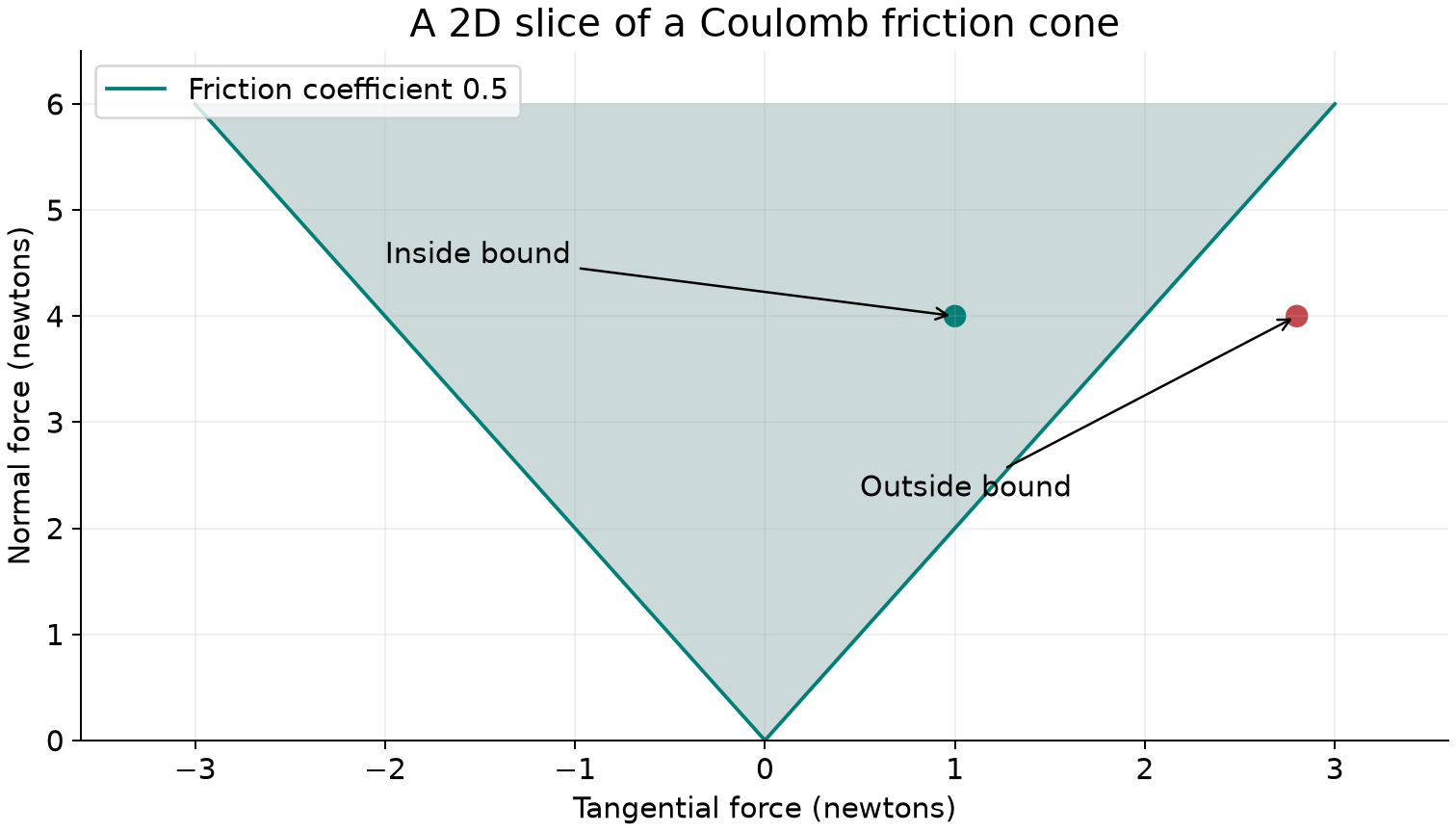
Two-dimensional slice of an ideal friction cone with coefficient 0.5.
The full 3D cone for . The arrow is the force a fingertip needs from the contact to stay put, and the ring marks at the arrow’s height. With N, a 1.5 N sideways load in any direction sticks. A 2.6 N load exceeds the 2 N bound, so the fingertip slides; the slide is drawn, not simulated. Pressing with 6 N raises the bound to 3 N, and the same load sticks. Source: Tools/animations/ch14_friction_cone.py.
If newtons and , the ideal tangential bound is 2 newtons. This does not tell you how much force is safe for a fragile object or a particular gripper.
Compliance and impedance
A compliant controller allows displacement under contact rather than trying to enforce a rigid trajectory at any cost. A simplified Cartesian impedance relation is
is stiffness and is damping in compatible coordinates. The relation expresses a desired interaction behavior; realizing it on hardware requires suitable sensing, control, and actuator support.
Why sensing matters
Vision can show where fingers are, but may miss whether an object is securely grasped. Tactile sensing adds evidence about pressure, contact, or slip. Proprioceptive or motor-current signals can also help, though they are not interchangeable with calibrated force measurements.
DexCap - 2403.07788 and RealDexUMI - 2606.06033 explore richer dexterous data collection. Dexterous Cable Manipulation - 2502.00396 illustrates deformable-object complexity.
Your scope
A two-finger SO-101 gripper can support useful manipulation research without matching a human hand. Choose tasks whose difficulty is observable and repeatable, such as grasping across small position changes. Do not make a dexterity claim solely from a successful lift: specify orientation changes, contact transitions, or recovery behavior.
Exercise: why might increasing position-controller stiffness make insertion worse?
Small alignment errors can produce large contact forces and jamming. Compliance may tolerate error, although too much compliance can reduce precision and must be designed for the task.
After the exercise: two impedance controllers, and N/m, each with damping ratio 0.7 on a 1 kg end effector. Both get the same command, which ends 2 cm past a wall. The stiff one tracks within 0.3 mm before contact but settles at 36.4 N against the wall. The compliant one lags by up to 3.4 mm and settles at 4.0 N. Both see a short spike on impact (36.6 N and 22.2 N). Source: Tools/animations/ch14_impedance_wall.py.
For contact mechanics and manipulation planning, continue with MIT Robotic Manipulation.