15 Robot systems and deployment
Home | Previous: 14 Contact and Dexterity | Next: 16 Evaluation and Uncertainty
Robot learning is a systems discipline. A policy depends on calibrated sensors, synchronized data, consistent units, available compute, and a controller that executes the intended action.
Trace a single action
sequenceDiagram
  participant Cam as Camera
  participant P as Policy
  participant C as Controller
  participant R as Robot
  Cam->>P: Image with capture timestamp
  P->>P: Preprocess and infer
  P->>C: Bounded action and intended time
  C->>R: Execute command
  R->>P: Timestamped joint state
Measure end-to-end delay from image capture to physical command application. Timing only the neural network misses camera buffering, preprocessing, transfer, queuing, and motor communication.
This is an accounting model for sequential stages; overlapped pipelines require tracing timestamps rather than blindly summing timings. Report median and tail latency, such as the 95th percentile, because rare long delays can disrupt control.
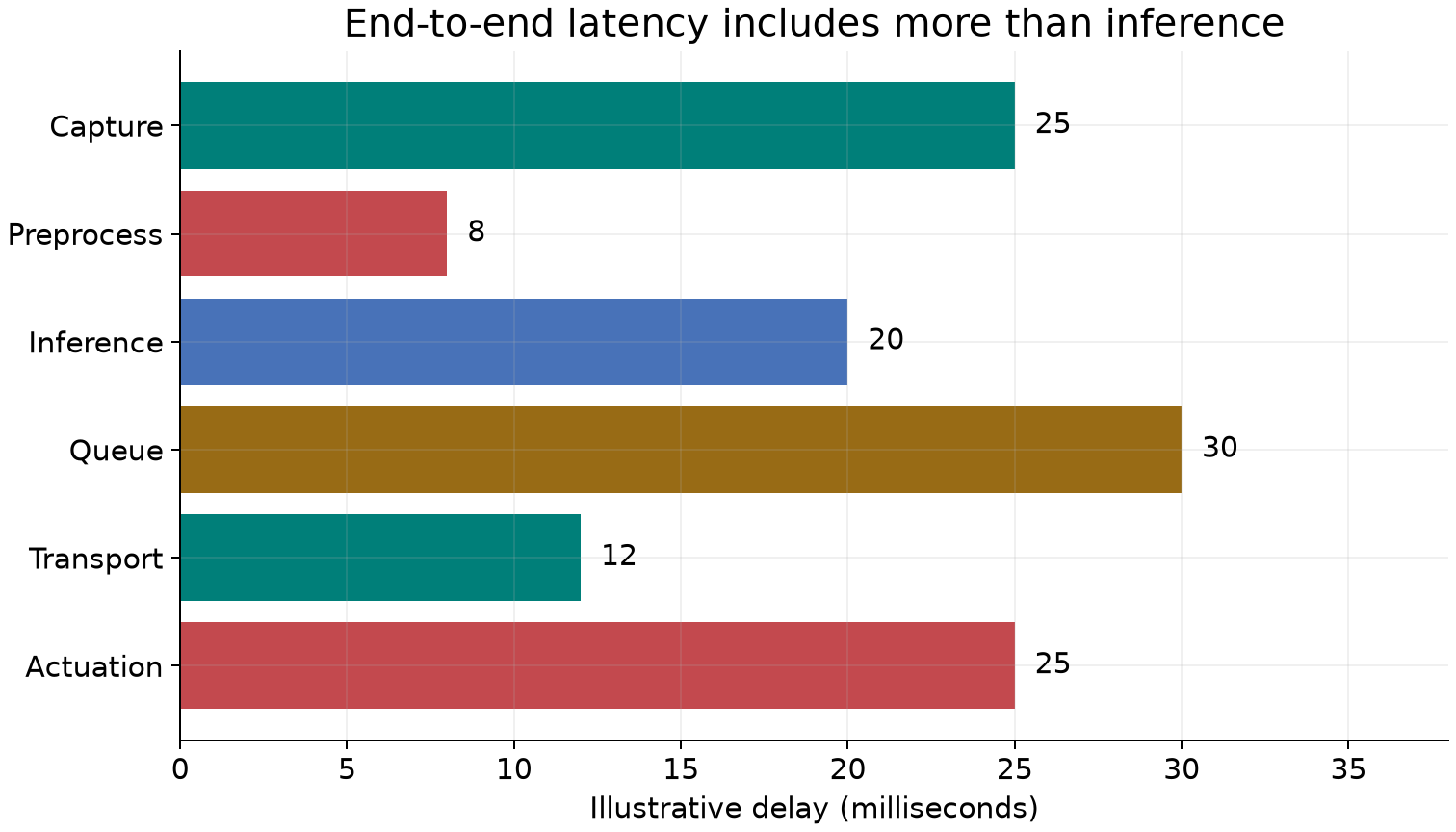
Invented example budget for teaching only. Measure your own hardware.
The deployment contract
Record which camera corresponds to each model input, image color order and resolution, joint names and ordering, action meaning, normalization statistics, timestep, and model checkpoint. A checkpoint without this contract may be impossible to reproduce.
Your existing lerobot note lists serial devices, but device names can change after reconnecting. Verify identity before commanding motors. Establish motion bounds, low-speed checks, an accessible stop, and supervision before policy rollouts. These are part of running an experiment, not replacements for the robot’s hardware procedures.
Resource-aware experiments
Use an existing framework for the core control and learning workflow. The official LeRobot documentation describes integrated hardware, dataset, and policy tools; consult its real-world imitation guide for version-specific commands.
Exercise: your network takes 20 ms but observed end-to-end latency is 120 ms. Should you immediately use a smaller network?
Profile the remaining stages first. Reducing inference to 10 ms saves only 10 ms if buffering or queuing dominates.
Portfolio deliverable: a reproducible setup guide and timing trace. Research connection: Latency and Chunking Study.